
Externalities diagram
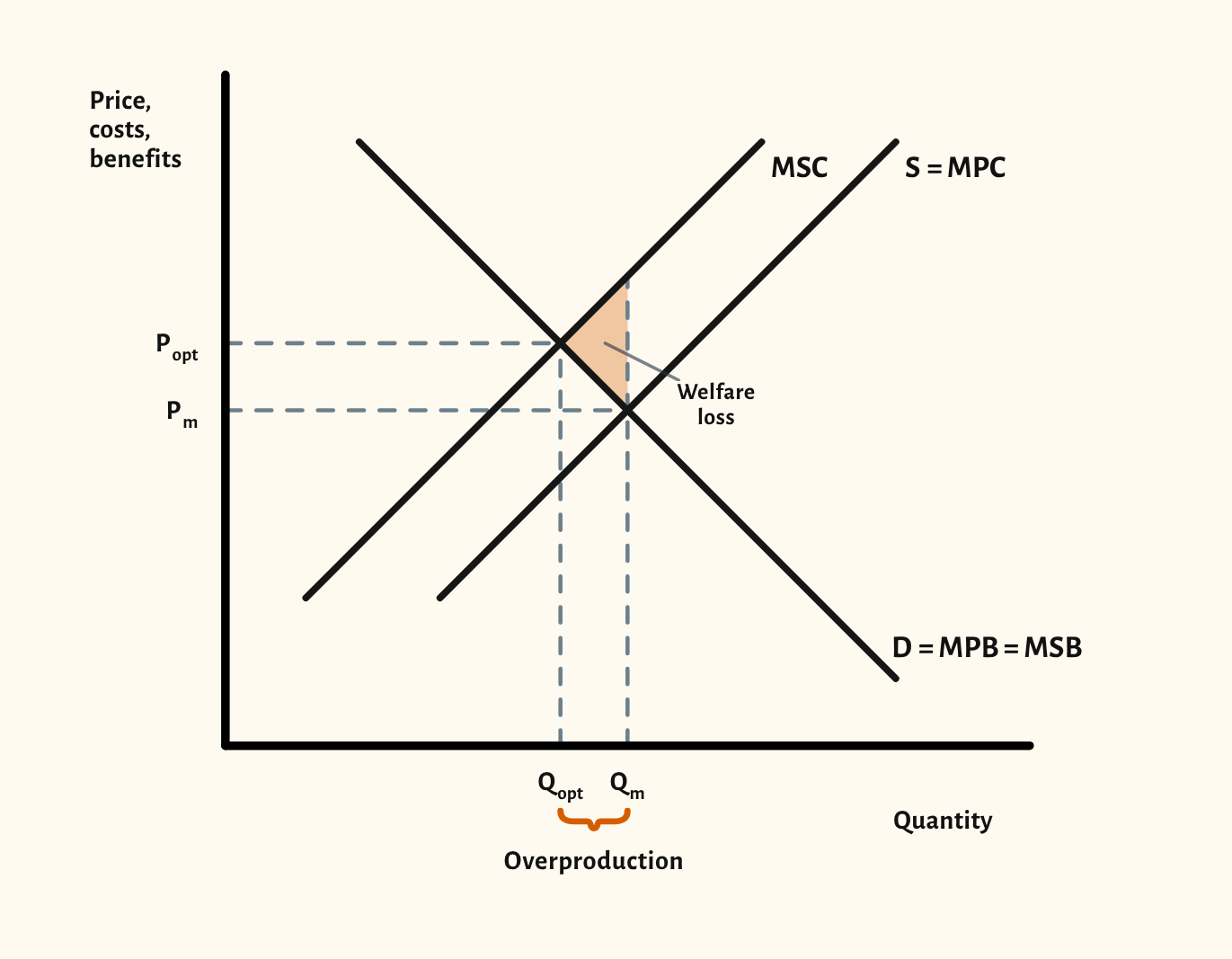
Negative and positive externalities in production and consumption, with private and social curves, the optimum and the welfare loss shaded.
Included in the school licence.
Teaching notes
Externality diagrams are where a class first has to keep private and social costs and benefits apart, and the labels matter as much as the lines. The starting point shows a negative production externality: marginal social cost above marginal private cost, the market quantity above the social optimum, and the welfare loss triangle shaded.
The scenarios cover the other three cases: a negative consumption externality, a positive production externality and a positive consumption externality, each with its own curves labelled in exam style and the underproduction or overproduction marked on the axis.
Further scenarios show the policy that corrects an externality. A tax equal to the marginal external cost moves supply up to MSC, so the market settles at the optimum and the welfare loss goes; road pricing is the same diagram, charged per journey. A subsidy equal to the marginal external benefit does the same for a positive externality. Two information gap scenarios show a demerit good and a merit good, where consumers act on the benefit they perceive rather than the actual benefit.
In a lesson, try asking the class which way the welfare loss triangle points before you switch case, so they see why it always sits between the market and optimum quantities. It leads naturally into the government intervention diagrams, where a tax or subsidy closes the gap.
What you can show
Each of these is one click in the diagram's Scenarios menu, and each starts from the plain diagram.
- Negative consumption externality
- Positive production externality
- Positive consumption externality
- Tax to correct a negative externality
- Subsidy to correct a positive externality
- Road pricing
- Information gap – demerit good
- Information gap – merit good
Exam boards
On the Edexcel A, Edexcel B, AQA, OCR, Eduqas, WJEC, Cambridge International and Edexcel International A-level specifications, drawn in exam style: black lines, clear labels and no grid.