
Price discrimination diagram
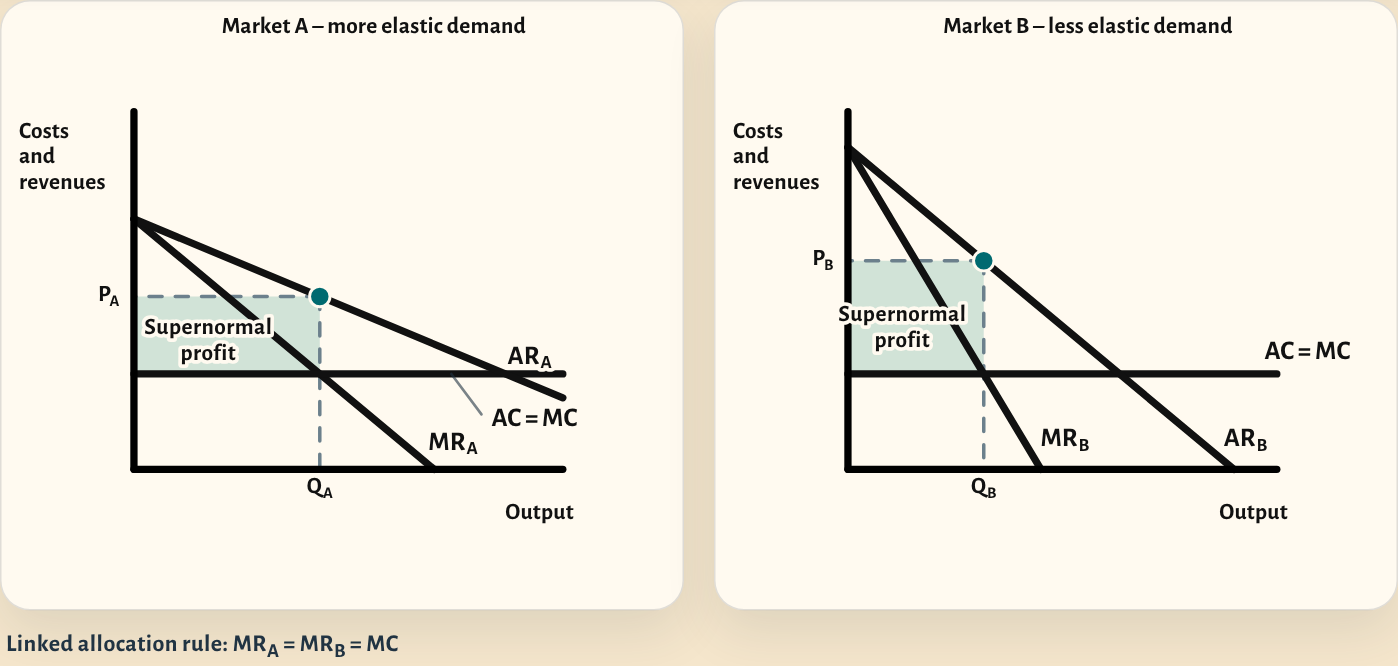
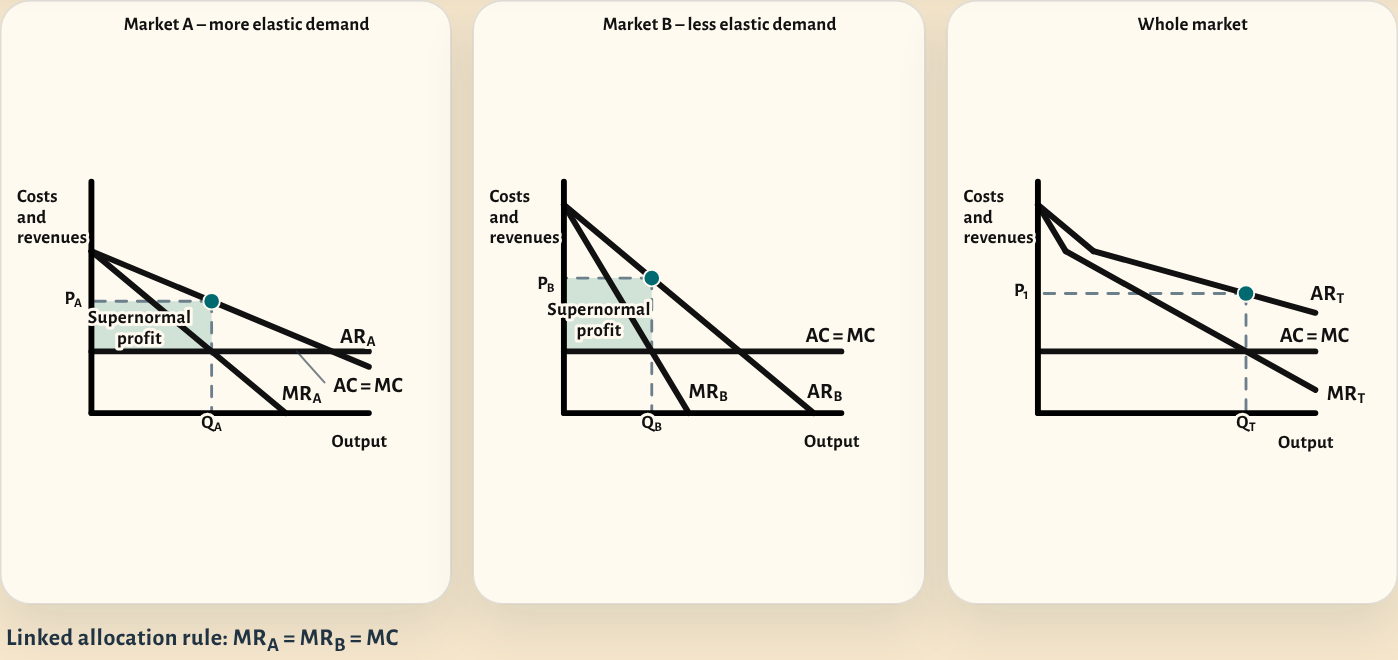
Third-degree price discrimination with two markets side by side, a higher price where demand is less elastic, and the whole market for comparison.
Open this scenario in CueCurve
Included in the school licence.
What the diagram shows
A firm with market power can charge different prices to different groups for the same product if it can separate the markets and stop resale. In third-degree price discrimination it sets output where marginal revenue equals marginal cost in each market: MRA = MRB = MC.
The market with less elastic demand, such as business travellers or peak-time users, pays the higher price; the market with more elastic demand pays less. Supernormal profit is higher than with one price for everyone, because the firm captures more consumer surplus. The diagram is drawn with constant costs (AC = MC) so the comparison stays clear.
One more scenario
Drawing it in an exam
- Draw the two markets side by side with the same vertical scale, labelled with their elasticity, and the same MC line across both.
- Set output where MR = MC in each market, then read the price up to that market's AR curve.
- Show the higher price in the market with less elastic demand, and shade the supernormal profit in each.
- State the conditions: market power, separable markets with different elasticities, and no resale between them.
Your exam board
Choose your board to see where this sits in its specification and what its mark schemes look for.
Edexcel A
- Specification
- 3.4.5 Monopoly, including third-degree price discrimination.
- What its mark schemes look for
- Examiners keep asking for diagrams that are accurately drawn, fully labelled and used in the answer, and a top-level essay often needs an accurate diagram.
Edexcel B
- Specification
- We haven't recorded the exact specification point for this board yet.
- What its mark schemes look for
- A diagram on its own earns at most 4 of 6 marks: the answer has to explain it. Diagrams should be fully labelled, with the original equilibrium shown.
AQA
- Specification
- 4.1.5.7 Price discrimination.
- What its mark schemes look for
- Short Draw questions are marked by counting labels: both axes, every curve, and the prices and quantities. No title or grid lines are needed.
OCR
- Specification
- We haven't recorded the exact specification point for this board yet.
- What its mark schemes look for
- Diagram marks are listed point by point: axes labelled, curves labelled with the right shift, and the old and new equilibrium marked.
Eduqas
- Specification
- We haven't recorded the exact specification point for this board yet.
- What its mark schemes look for
- The top bands reward a diagram that is accurate, well labelled and referred to in the writing. A diagram that isn't used drops a band.
WJEC
- Specification
- We haven't recorded the exact specification point for this board yet.
- What its mark schemes look for
- Axes must be labelled for the market in the question, and a question that asks for 'diagrams' expects more than one.
Cambridge International
- Specification
- 7.8.3 First-, second- and third-degree price discrimination.
- What its mark schemes look for
- The shape needn't be exact, but slopes must go the right way, curves that should meet must meet, and every curve and axis needs a label.
Edexcel International
- Specification
- 3.3.3 Monopoly, including third-degree price discrimination.
- What its mark schemes look for
- Draw questions give a mark for labelled axes and the original curves, then marks for the change and the new price and quantity. The diagram alone can earn every mark.
With a school licence, the How often page in CueCurve lists the exam questions each board has asked that call for this diagram.
Paraphrased from published specifications, mark schemes and examiner reports. How we check
In CueCurve you can also
- Build the diagram line by line in front of the class with Step by step, so they see the order to draw it in.
- Drag the curves live and switch scenarios in one click, starting from the plain diagram each time.
- Present it full screen, draw on it with the pen, and save it into a lesson.